
|
|
||||

|
|
||||

|
|
||||

|
|
||||
|
|
||||

|
|
||||

|
|
||||

|
|
||||

|
|
||||

|
|
||||

|
|
||||

|
|
||||

|
|
||||
|
|
||||

|
|
||||

|
|
||||

|
|
||||

|
|
||||
|
|
||||

|
|
||||

|
|
||||

|
|
||||

|
|
||||

|
|
||||

|
|
||||

|
|
||||

|
|
||||
I find myself spending less time on games and more time on online classes - four published, one in the making. I am not presently writing any books because they are too much effort for the return.
Most recently published game: Dragon Rage Second Edition, Flatlined Games, Belgium (www.flatlinedgames.com), January 2011.
Those interested in playtesting Pulsipher games should write to me: [email protected]; and consider joining the Yahoo Group pulsipherplaytesting: http://groups.yahoo.com/group/PulsipherPlaytesting
My Game Design Blog: http://PulsipherGameDesign.Blogspot.com.
Thumbnails leading to maps are at the end of the page.
I am dividing the following into categories of games: "Euro-wargames", "Brit-like games", and "others". Some of these games are currently under consideration by various publishers, but I am not going to indicate that below.
Last revised June 2011.
Euro-wargamesThese games are designed as crosses between "Euro" style games and historical wargames. Among the characteristics I'm aiming for:
"Any intelligent fool can make things bigger, more complex, and more violent. It takes a touch of genius -- and a lot of courage -- to move in the opposite direction." --Albert Einstein
|
|
EurasiaHas been licensed to a publisher "2,000 years of history in 90-180 minutes". Two to five (six?) players control empires of Europe and Asia as they rise and fall, from the Romans to the Mongols. There are no chance elements in the game other than the choices of the players. This sweep of history game is free-flowing, somewhere between Britannia and History of the World. 17" by 26" board of Europe, North Africa, and most of Asia, and 175 pieces. For some years I've wanted to make a game with the virtues of Vinci (simplicity, quick play, diceless) but without the faults (abstract feel, "unrealism", severe leader-bashing and kingmaking, no economy). Eurasia has a board that actually matches reality, and the empires (and their special powers) are historical, yet it has free-form play rather than the so-called "scripting" of Britannia. It seems to be 90 minutes to two hours. It could be described as a cross between Vinci , History of the World , and Britannia. Yes, the board is the entire continent of Eurasia with N. Africa included! In 47 areas... see graphic below. |
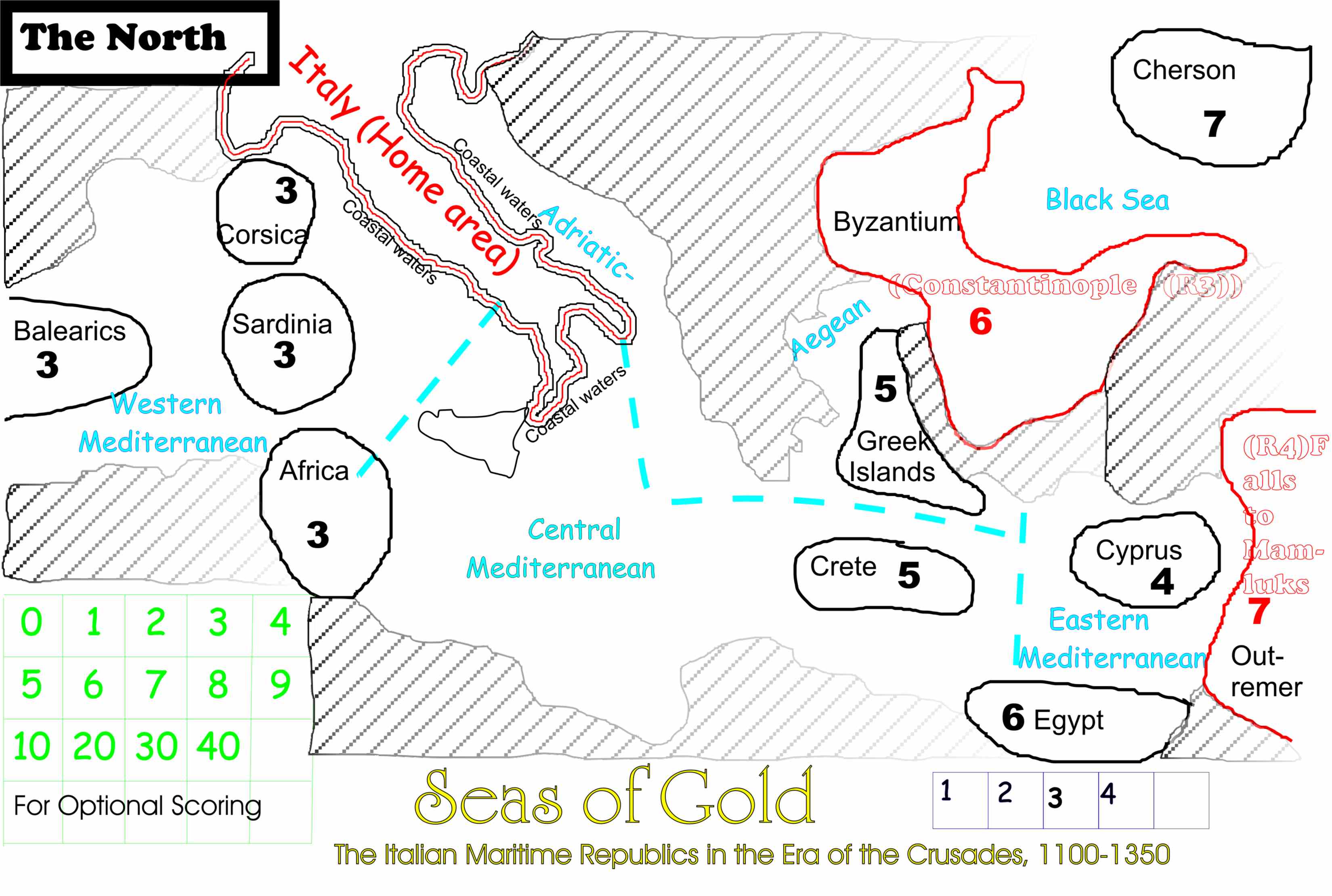
Seas of Gold(Italian Maritime Republics in the Era of the Crusades)Game "treatment" for publishers. Playtester reaction has been exceptional--the most favorable I've ever seen, except for Law & Chaos. And I've had several dozen games playtested over the years. This game is closer to "Euro-style" than any other that is far along in testing, though typically longer than most Euro games. Players compete to accumulate gold, culture points, and islands in the Mediterranean world. Players must plan their use of "Action Cards" that restrict what they can do at a given time. They lay down six Action Cards at the start of each round (four rounds per game), then play each card in turn. Each player controls 6-15 pieces (armies and fleets) during the game. While aggressive play may gain control of more islands, it is also expensive. Event Cards help alter the course of play, though not radically. This system works very well, and has already spawned three other games. |
ColoniaI think of this as the "one hour wargame". It roughly represents colonization in the ancient Mediterranean, followed by empire-building and warfare. It is possible to win without fighting other players (though you're likely to fight barbarians). Players choose their "action" from amongst a limited set of choices and play their choices simultaneously. These actions include Diplomacy as well as Trade and Colonization, amongst others. Players then execute in "initiative" order, some actions having better initiative than others. They score at the end of each of three rounds, one point per "progress" marker and one per colony. There is no chance in combat, in fact dice are not used at all. Event cards add historical flavor and variation to the game. Is it really one hour? With a strict time limit, yes; otherwise it can take closer to two. There is a slightly more complex version, as well.
|
Stars of GoldThis game uses some of the principles of Seas of Gold, but is a game of exploration, expansion, and exploitation of a galaxy. Inevitably, it is more "wargamy" than Seas. Unlike most games of this type, chance plays very little part (even in the exploration) in the game. |
The Rise and Fall of Assyria:History of the Ancient Near East"2,000 years of early history in two to three hours". Two to five players control ancient empires as they rise and fall, including the dour, hated, ultimately doomed Empire of Assyria. There are no chance elements in the game other than the choices of the players. This sweep of history game is much less restrictive than Britannia (though there is a four player Britannia-like version) but much more historical than History of the World. 2 to 3 hours. 17 by 22" board of Egypt, Anatolia, and the near east, and 200 pieces.
This is a cross between Eurasia and Britannia. Each player controls just two nations at a time, but will control several over the course of the game. It follows, more or less, the history of the area in ancient times. There is also a free-form version (like Eurasia), and a more historical version reminiscent of Britannia, but no dice--though there is an option to use dice. With that title you can figure that the game covers ancient near-eastern history, 2600 BC to 500BC, Mesopotamia, Anatolia, Armenia, and Egypt. 55 cards, less than 300 pieces.
|
Dominanceof the old WorldThis game is meant to fill the niche occupied by Risk (and later by Vinci), while fixing the major problems with traditional Risk--so it ends up being quite unlike Risk. That niche, of course, is a simple, easy-to-play, abstracted wargame. Dominance has two boards, of Europe and of S.E. Asia, but no specific time period or technology. How Dominance meets the five complaints about traditional Risk Length. Risk can be very long. Dominance is about two hours, depending on the number of players and their experience. I think experienced players could keep it to 90 minutes. However, Dominance is a strategic game, and players typically like to think about their options. Too much Dice/luck. There are no dice in the standard version of the game. Variation is provided by Event Cards. (There is a more Risk-like version that uses dice but no Event Cards.) Downtime. Sometimes players wait too long for their turn. Dominance uses a "committed intent" Action Card mechanism. Players all play their card face down, then turn them face up and play in initiative order. This varies the turn order and limits what a player can do when it's his turn, so he's less likely to think about it for a long time when he plays. Employment of Mass. In Risk, 40 armies attacking 2 get no better results than 3 attacking 2. When a mass of armies is used, they should take effect. But in Dominance the number of armies is limited by territories owned, so no more than about 50 will be in play altogether. Player elimination. Since Dominance is a turn-limited point game, and players can submit rather than be wiped out, player elimination is quite rare. We end up with a simple, strategic game with lots of replayability.
|
Pleiades ClusterA science fiction game involving war, technology, and culture for 2-6 players. Uses a version of the Dominance game system. It is possible to win without resorting to warfare, but you have to defend yourself... A two hour light (war)game. 110 cards, mid-size board, straightforward pieces |
|
GermaniaGame "treatment" for publishers Clash of Arms, 2015 This game roughly represents the history of the Germanic invaders who destroyed the West Roman empire, then themselves suffered invasions from the east, south, and north. My objectives here were to have historical game meet "German" or "Euro" game. Hence I wanted a relatively short game (as multiplayer wargames go), 90 minutes to two hours, no player elimination, little chance and no dice used in combat , no record-keeping, a lot of change (fluidity) over the course of the game. The game is for 2-6 players, though best, I think, with 3-5. Despite the resemblance of the name to Britannia, it is quite different.
|
|
Britannia-like games(Note: under US copyright law, no one can own game systems, ideas, and techniques. See http://www.copyright.gov/fls/fl108.html. ) |
|
Barbaria (formerly Dark Ages)I would call this game the natural successor to Britannia. This game covers the period from the fall of Rome to the Mongol invasion of Europe. There are three versions. The two smaller ones use the same board: one is a 90 minute game using "picture dice", the other is diceless. Both can use plastic figures. This is aimed more at "Euro" fans, though I wouldn't call it a Euro game. The largest version, for FIVE players rather than four, is played on a board with more areas, is of the more epic sort. Normannia: the Vikings in the WestDiceless combat. The developed version is 8 turns and simpler than Britannia, as is true of many of these games. The map depicts all of Britain, Ireland, and much of France and NW Germany. |
Hibernia: the Early History of Ireland"Chieftains, High Kings, and Vikings warring on the Emerald Isle." This is a combination of Britannia-like game and "block game". Three players (in itself as unusual as the setting) each control three or four nations in Irish history, from Christianization to the end of the Viking invasions. Each nation has independent point objectives, the player scoring the most points wins. Blocks provide "fog of war". 17 by 22" board of Ireland, 67 blocks, 27 cards, dice, and pieces representing monasteries, leaders, and forts/towns.
|
Arthuria: Adventus Saxonem"Can Arthur save the Britons?". Three to five players each control five or six nations in English and Welsh history, from the Roman invasion to the Norman incursions. Each nation has independent point objectives, the player scoring the most points wins. The game resembles Britannia, but is smaller, shorter, and simplifies scoring. 2 to 3 hours. 22 by 33" board of England and Wales and less than 200 pieces. Begins with "Adventus Saxonum", the coming of the Saxons, and ends around 700. Arthur plays a prominent part as Warlord (not King) of the Britons, who throw back the initial English invasion, then succumb. Players "choose up" sides (the nations they'll control) for greater variety. |
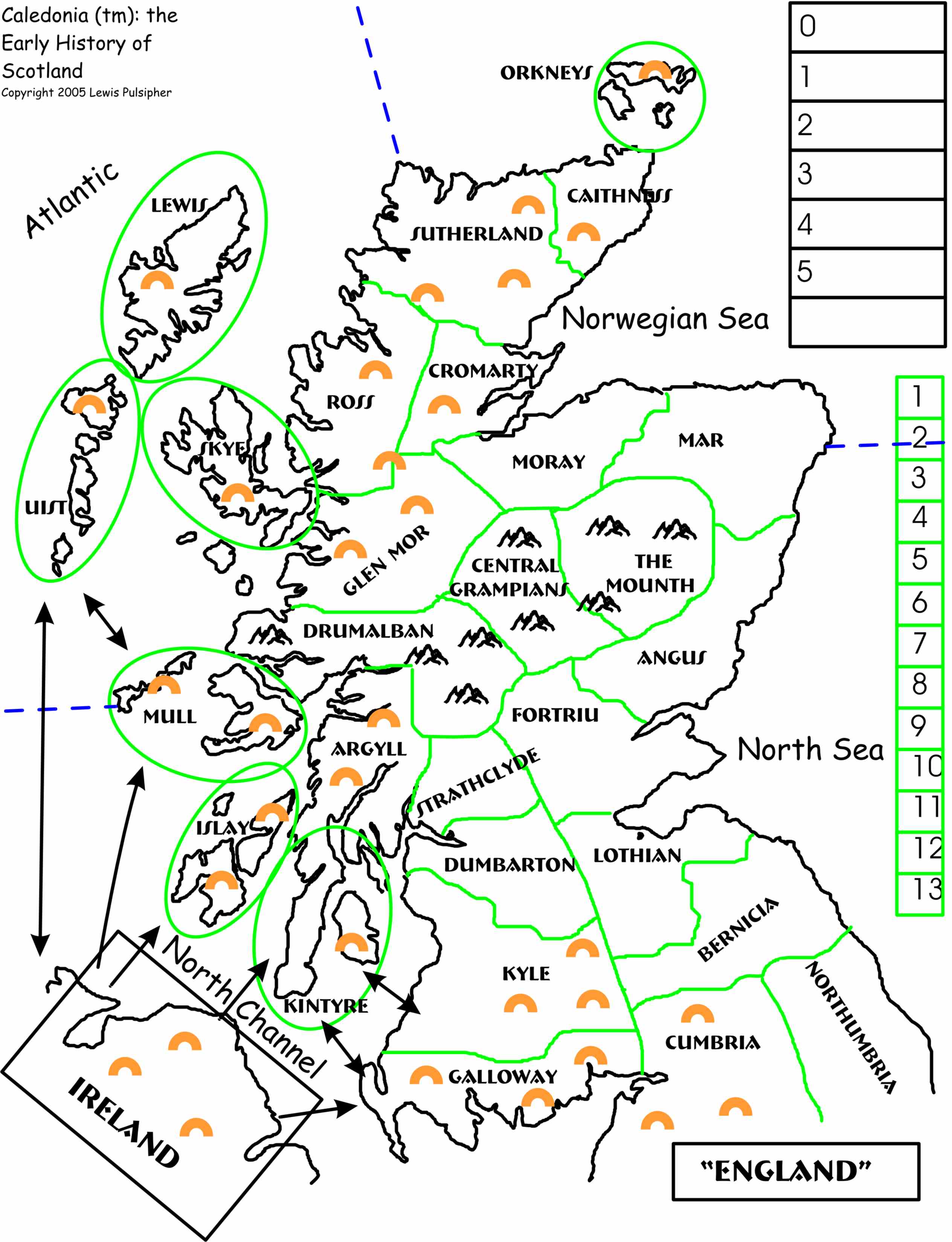
Caledonia: the Early History of Scotland"Scotland the Brave-before it became Scotland". Four players each control five or six nations in Scottish history, from the Roman invasion to the Norman incursions. Each nation has independent point objectives, the player scoring the most points wins. The game resembles Britannia, but is smaller, shorter, and simplifies scoring. 2 to 3 hours. 17 by 22" board and less than 200 pieces. This game is much like Britannia, but smaller and shorter. Scottish history, from the Roman invasion to the Normans and Norwegian king Magnus Barelegs. |
Hellenia: Alexander's Successors and the rise of Rome and CarthageThis game depicts the struggle of Alexander's Successors and the rise of Rome and Carthage, 313-146 BC. It's a very LONG board, with a lot of spaces, resulting in a fairly long game. |
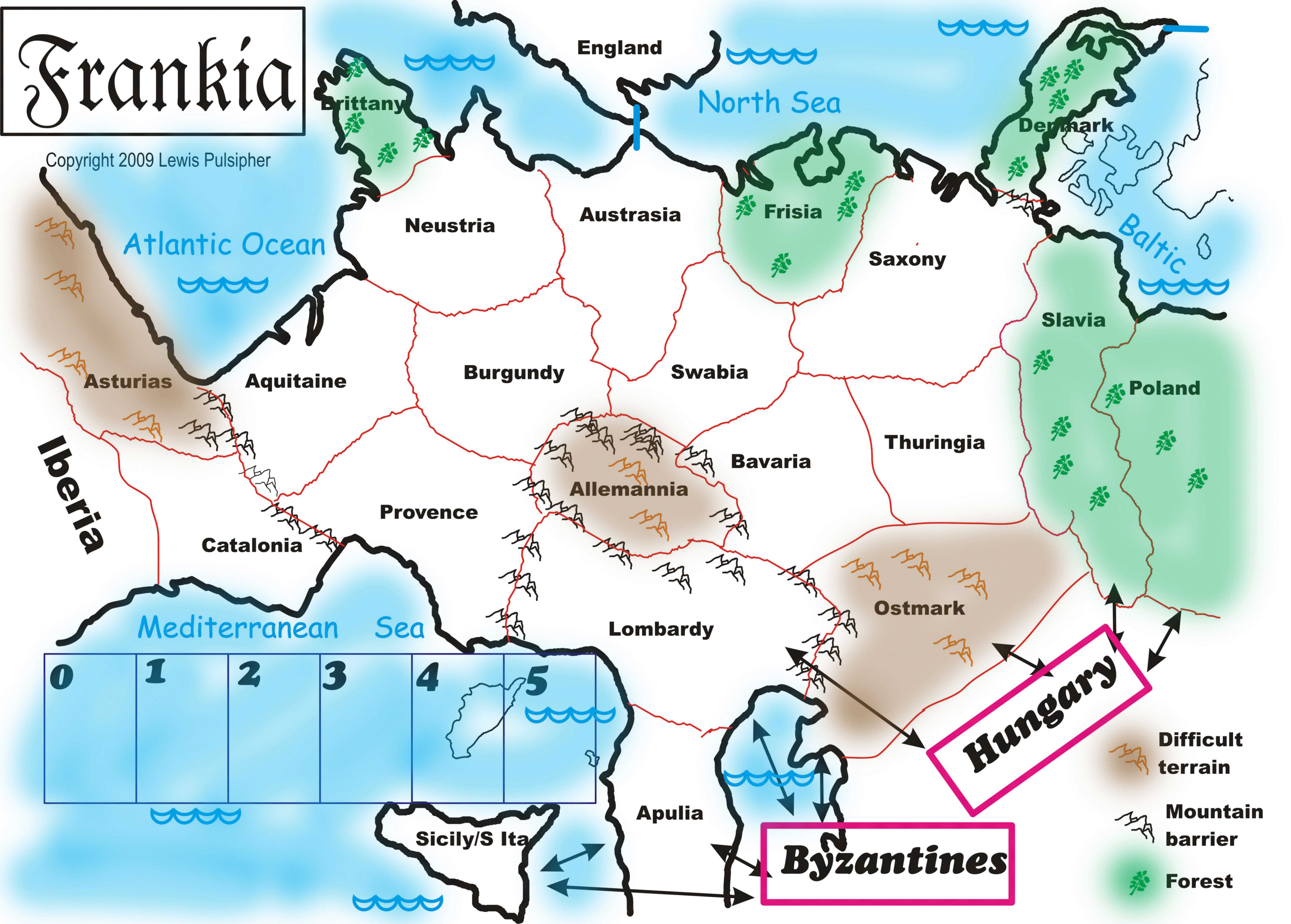
Frankia: the Birth of France and Germany"The Merovingians, Vikings, Charlemagne, Saracens, Holy Roman Empire, Magyars, and more" There are three scenarios in this diceless Britannia-like game, from the fall of the Roman Empire (406-814), from the Treaty of Verdun until the Battle of Bouvines (843-1215 or so), and a three player scenario from 1215-1492. Each scenario is eight turns. The board and number of pieces are smaller than in Britannia, thanks to a relatively bloodless card-based combat system. |
New Editions of BritanniaRule Britannia(Formerly "History of the British Isles".) This game covers the same period as Britannia, but includes Ireland. There are 21 areas, nine turns, about half as many armies, and much simplified point scoring. Battle cards are used instead of dice. There is an optional version using Event Cards. Intended to be played with plastic figures. You might call this "Britannia as it
would be designed today". Conquer BritanniaThis is a highly simplified version of Britannia, six turns,
many fewer areas on the board. I designed it originally as a "broad
market" game which could to some extent fit the Risk niche, where a bunch of
lads can get together to have it out with each other for 90-120 minutes.
It has been played in 1:24, though usually takes longer. Epic BritanniaThis is a revised version of standard Britannia that is better for teaching ("more realistic"). But it also has a "freeform" introductory version that lasts 2-3 hours instead of the usual 4-5 hour length.
|
|
Other games |
|
Kung FuThis is a very simple card game (110 cards and a score layout) with a kung fu theme, taking about 15 minutes to play. I started with the idea of making a "game with no rules", but in a card game that becomes too much like Fluxx, so I altered my objective, and ended up with something that is curiously "more-ish". I am a great believer in paying attention to playtesters, and people seem to like to play this game multiple times when they get hold of it. This is as close to a mass-market game as I have designed. A variation, with a different deck, is Day of the Undead. You want to avoid having cards in front of you, as you take wounds until you turn into an undead monster. Last one alive wins. |
The Star Princes"Take your interstellar inheritance before your brothers do!" A fairly simple space wargame for two (or more) players. Kill your sibling princes before they kill you and inherit your murdered father's interstellar kingdom. There is a strategic (geomorphic) hex board and a tactical board. Fog of war plays a part as ships begin face-down. Dice are used in combat. Economy rules in the end, but often the game is decided when a player's prince dies or his immobile orbital fort is destroyed. (The board looks great, if I do say so myself.) There are also special two-player scenarios such as an attack by killer machines, rebels against the empire, and space barbarians. The board looks great, if I do say so myself.
|
Currents of SpaceGame "treatment" for publishers This is a chess-like game that has no resemblance, in mechanics, to chess. It represents two Galactic Powers fighting for control of a galaxy. The "Currents" of the title refers to the paths that can be followed by different types of space warships.
|
French Revolution ("Anarchy") Game called Vive La FranceFor 2-6 players. Vive La France is a representation (but not simulation) of the anarchy in France in the early days of the Revolution of 1789. The game began as a representation of governmental anarchy... Each player represents no one person or group, but controls a variety of groups or "factions". Each faction has different goals, reflected in differing methods of garnering Victory Points. When the game ends, the player who has collected the largest number of Victory Points wins the game, regardless of the number of provinces held or number of troops controlled. |
DoomstarA Stratego-like game in appearance, though much more fluid. Two players each control a space fleet including such units as fighters, "negasphers", and the "Doomstar". The objective is to destroy the opposing command ship or planet. 20 minutes for the introductory game (19 pieces per player), which has proved to be very popular with playtesters. |
Law and ChaosPublication contracted with Mayfair Games This abstract game combines careful placement of "stones" on a board with changing victory conditions and capture methods. 30-40 minutes. |
Viking GamesWhile redoing Britannia, I became fascinated with the Viking Age; several games have arisen from this.
Sea KingsVery near to licensed to a publisher "Land, Wealth, and Fame". A simple, short, easy to play game using 84 custom cards, emphasizing the Viking trilogy of desires. Players accumulate those three by raiding, settling, trading, and discovering new places. Includes a scoresheet, an 8" by 11" map of the Viking Age, and figures or other objects to identify each of 2-8 players.
|
Gangsters:Taking Care of Business"It's not personal: it's just Business" Game "Treatment" for Publishers 2-6 racketeers try to build up their "businesses" (such as betting operations) in a Prohibition Era city. While this seldom results in murder (that's bad for "business"!), there is a lot of mayhem involved as thugs, illegal liquor, hit men, the longshoremen's union, tax evasion, legal "mouthpieces", bribes, crooked cops, Feds, and protection rackets come into play. 55 cards plus 20 smaller cards, scoresheets. 30-40 minutes While the game uses the hollowed (and familiar) "draw a card, play a card" sequence, it is unique because everyone sees (and has a chance to take and substitute) the card that ultimately goes to the player whose turn it is. Except when a card is part of the initial deal, every player will know who has, for example, the St Valentine's Day Massacre card, or the Eliot Ness card. The deck includes three major kinds of cards, rackets (which score points at endgame), enforcers, and actions. The objective is to score points at the end of the game (which occurs soon after the deck of 55 cards is used up). During a round the top card of the deck is revealed; each player in turn can swap that card for one in his hand, which then passes to the next player; the last gets whatever is left. Hence players know who has which cards, aside from the original deal. The last player plays a card onto the table (representing three areas of the city), or plays an action card. Enforcers protect your rackets and can "bust up" your opponent’s. The game tends to have a building up phase followed, near the end, by a fairly "bloody" phase during which many rackets and enforcers are removed from the table. This is a fairly complex family game, and a light game for wargamers and others who do not mind "doing the dirty" to their competitors. |
The Four ElementsThis is a Euro-like game, a race to "mastery of the four elements". The Master of the Four Elements has retired, and the guild is conducting a contest to select a new Master. You and several others are trying to be the first to move through the Path of Mastery to reach the central space. Each player has a specialty to help him manipulate the elements. The key is to collect the right combinations of cards to move you from one area to another along the path. Aside from the board the game uses figures to represent the wizards, and a deck of 64 cards consisting of element and color combinations. Forced trading of cards is a feature of the game; dice are not used. |
Interstellar Master Miners (IMM)This is a simple, fairly abstract game of placement and (in the "wargame" version) movement. Two to eight players, relatively short.
"Avoid the undead" This is a very simple "avoid the undead" card game for 2-8 players,
taking 30-45 minutes to play. It follows the standard mechanic of play a
card, draw a card, but the cards do a variety of things. Players try to
avoid having Undead cards in front of them, and play cards to cause the
undead to wound other players or move undead cards. If you lose all your
health points, you become Undead! Last to survive wins, though on rare
occasions everyone loses!. 110 cards, 8 by 11" scoresheet, two markers per
player. Rules 1,100 words not counting examples.
|
Dirty Tricks"Of Course I'm a Nice Guy" The game represents an attempt to win election to a major statewide post such as governor or senator. This game uses a deck of 55 cards plus 20 smaller cards, and "coins" representing campaign funds. The deck includes two major kinds of cards, voters (which score points at endgame) and actions. The objective is to score points at the end of the game (which occurs soon after the deck of 55 cards is used up). During a round the top card of the deck is revealed; each player in turn can swap that card for one in his hand, which then passes to the next player; the last gets whatever is left. Hence players know who has which cards, aside from the original deal. The last player plays a card onto the table (representing three areas of the city), or plays an action card, or uses campaign funds. Money can be used to entice voters from another camp. There are televised debates, dirty tricks, media, minorities, This is not a "pretty" picture of how politics works. Money counts for a lot. It is a fairly complex family game, and a light game for wargamers and others who do not mind "doing the dirty" to their competitors. About 45 minutes, 2-6 players.
|
Zombie Escape!This is a game played with cards, the cards providing the board, the "pieces", and the events and occurrences. 110 cards and one die required. Young people (and some older ones) love zombies for some reason. This game is about escaping from a reform school building that has become overrun with zombies. Each player is a character (described on a card) with varying capabilities. As they try to escape, characters come across zombies, potential weapons, and other helpful items (such as fire extinguishers). There is no player elimination: if you lose a fight, you just retreat back toward the starting location. Whoever finds a door to the outside, and manages to get it open (they're all locked), wins the game. About 45 minutes for five players, works with almost any number of players up to nine or ten. |
Scrooge!" Mine!"In this dice and card game for 3 to 8 players, the objective is to collect target (objective) cards, often from other players, by meeting the objective with a dice roll; when a player runs out of cards and the round ends, the player with the most points wins. A game takes 15-40 minutes depending on the number of players. From descriptions of Knizia's Easy Come, Easy Go I gather that there is a resemblance to this game. Scrooge was 95% developed before ECEG was released.
|
Warp"Warp your way around the Black Holes and win the race" This diceless, cardless game of strategy rewards a clear eye for angles and possibilities. As with many classic games, it is simple to learn but not simple to master. Two to four players try to move their spaceships to the other side of the board before any opponent can. Place and use Black Holes to slingshot/warp through crowded areas faster than your opponents. Watch out for captures that will send you back to the starting line. Many variations are included. 65 markers, 17" by 17" board. It has been described by a tester as a cross between Chinese Checkers and Chess.
|
1914: the Lights Go OutWorld War I in Europe and the Mediterranean, best for five players but allows 2-8. The key to the game is a method of controlling neutrals, combined with "committed intent" Action Cards. No dice are used. Units are armies and fleets, which can be "depleted" without being destroyed. Entrenchments are an optional rule, as the "realism" of the trenches leads to a static game (surprise!). Instead, it is entirely possible, for example, for France and Spain to conquer Britain even as British-controlled Italy temporarily takes Paris. |
Imperialism 1898:the Scramble for AfricaThe game represents the European "Scramble for Africa", the grab for territory in Africa in the late nineteenth and early twentieth centuries. The game is for 3-6 players. The Standard version is for five players: Austria-Hungary, Britain, France, Germany, and Russia. Each player is able to control some of the minor countries involved (Italy and Ottoman Empire are the largest of these). The game resembles Diplomacy in many ways, including simultaneous movement, but is a victory point game, much reducing length and making player elimination most unlikely.
|
18th Century: the Struggle for Hegemony in EuropeThis is an historical game for three to five players. Each of the ten Rounds represents about ten years of eighteenth century European history. The game depicts the era of "civilized", limited warfare following the reaction to the excesses of the Thirty Years War, and ends just as the French Revolution and the change to national armies begins. Bears some resemblance to Britannia insofar as each player controls a different set of nations. Dice are used to resolve combat, but in a unique manner. Fortresses are important, and armies are rarely wiped out. Unlike typical Britannia-like games, the three and five player versions are just as viable as the four player. |
Carolina Roll'emSomething like Law & Chaos, but there is no board or pieces, instead players roll dice; the cards govern how many dice are rolled and the objective of the roll. A very simple game for several players. There's an element of "messing with" the other players, but chance still plays a considerable part. Although the rules bear no resemblance, I had "Liars Dice" in mind as I designed this one. Can be played by younger kids and older grandparents. 110 cards, six dice, one scoring marker per player, scoring sheet.
|
YAARRRRH!"Fortune sits on the shoulder of him what schemes." Two to seven players are pirate leaders capturing ships on the Spanish Main. Begin with a pirate cutter, recruit more crew, avoid the hunting warships, add ships to your fleet, interfere with your rivals, capture a town or Spanish silver fleet if you're lucky, and accumulate the most Loot to win. The game uses hands of specialized cards (110), and dice. A "screwage" game something like Bang! or Nuclear War but without player elimination.. 1 to 2 hours depending on players. "Beware the Black Spot!" A card-based. turn-based game where players are pirates trying to get loot (usually by capturing ships) on the High Seas. Influenced both by history and by romantic and fictional ideas about pirates. Like Zombie Apocalypse, this is a "screwage" game--you have many opportunities to mess with your friends/mates. 110 cards, miscellaneous markers, dice.
|
Survival!"Can you cope with the aftermath of the apocalypse?" This is a simple card game, with dice, for 2-7 players. Players represent groups that have experienced the Apocalypse and are trying to survive (as in The Road Warrior and Mad Max: Beyond Thunderdome). They collect survival items such as vehicles, food, and medicine, which are periodically used up as the players score survival (victory) points. They may choose to raid other players to steal items. When you play a scoring card, everyone can turn in matching survival items for points. Game length 30-60 minutes, 110 cards, two dice, 8 by 11" scoresheet, one or two markers per player, rules under 2,000 words. Tortuga: the Pirates Game"Why did you do that to me?" "Pirate." A simple diceless game for 2 to 7 players, suitable for families as well as confirmed gamers. Players collect victory point cards, often by stealing from other pirates; when you play a scoring card, everyone scores according to the picture and color of the VP cards, with some restrictions. Variable length according to point objective, typically half an hour but can be as short as 15 minutes. 110 cards, 8 by 11" scoresheet, two (or three) markers per player. Rules 1,100 words not counting detailed example. |
Zombie Apocalypse"Run for your lives!" The Zombie Apocalypse is here, with each of 2-7 players representing a small group of survivors. The last survivor "wins". The game uses hands of specialized cards (110), and dice. Players often play zombies against other survivors. A "screwage" game something like Bang! but without player elimination. An hour or more depending on number of players. "Send those zombies down!" This Bang!-like card game has proved to be very popular with college- and high school-age playtesters. Each person is a group of survivors; when you've lost every person in your group to the zombies played by other players, you become a zombie player. 110 cards, people markers, dice. |
Battle of HastingsA simple two-player game using cards to represent the Battle of Hastings, 1066. Ancient and medieval battles were confused slugfests, and this one offered no opportunities for flanking or clever dispositions. In order to make it a more interesting game, I have given players more control than Harold and William could have exercised. 55 cards, one die, markers for the two leaders. Quick Guide How to Play (unformatted) |
|
|
|
|||||||||
|
|
|
|||||||||
|
|
|
|||||||||
|
|
|
|||||||||
|
|
|
|||||||||
|
|
|
|||||||||
|
|
|
|||||||||
|
|
|
|||||||||
|
|
|
|||||||||
|
|
|
|
|||||||||
Other projects of note: